La lutte mondiale contre le changement climatique et la réduction des émissions de gaz à effet de serre sont devenues des objectifs communs à presque tous les pays, les Nations Unies les ayant officiellement adoptés comme objectif de développement durable en 2015. Comme pour toute initiative politique à grande échelle, la mise en œuvre de mesures visant à freiner le réchauffement climatique et à réduire les émissions de gaz à effet de serre nécessite un financement adéquat. Depuis sa création, la Conférence des Parties (CoP) a confié aux États la responsabilité principale de mettre en place les mécanismes financiers à cette fin, en s’appuyant largement sur leurs capacités financières. Cependant, cette approche a évolué et le protocole de Kyoto, adopté en 1997, a abouti à la création de marchés sur lesquels les entreprises peuvent se procurer des crédits carbone (équivalents à 1 tonne de CO2) afin d’atteindre leurs propres objectifs politiques en matière de lutte contre le réchauffement climatique. Toutefois, le cadre juridique régissant ces crédits carbone reste ambigu. Parallèlement à ces nouveaux instruments financiers, la pratique a développé d’autres instruments financiers liés à la réalisation d’objectifs environnementaux spécifiques. Afin de garantir la prospérité et l’efficacité de ces marchés dans la contribution à l’objectif du développement durable, il est essentiel de mettre en place un mécanisme de justice privée impartial et neutre pour résoudre les litiges juridiques découlant de ces nouveaux instruments financiers.
L’objectif principal de ce projet de recherche est donc de mettre en place un mécanisme de résolution des litiges, l’arbitrage international, dont les règles pourraient être adaptées pour mieux répondre aux besoins de ces nouveaux instruments de la finance verte.
Ce projet est mené conjointement par l’École de droit de Sciences Po et la Faculté de droit, d’économie et de gestion de l’Université Paris Cité, et est dirigé par Diego P. Fernández Arroyo et Caroline Kleiner.
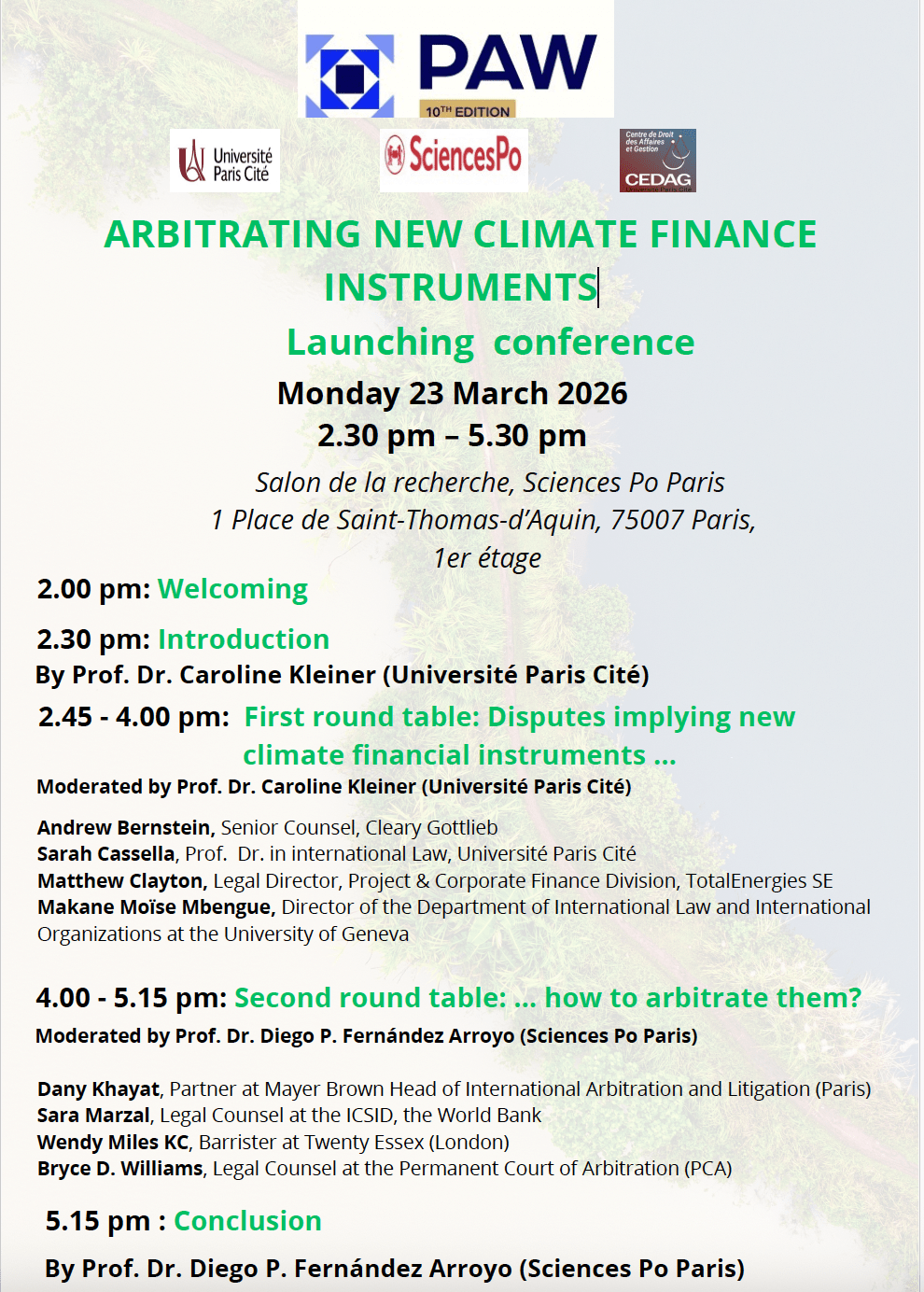
Launching conference: lancement du projet de recherche « Arbitrating New Climate Finance Instruments »
Se tiendra le lundi 23 mars 2026, de 14h30 à 17h30, au Salon de la recherche de Sciences Po Paris (1er étage), 1 place de Saint-Thomas-d’Aquin, 75007 Paris), le launching seminar intitulé :
« ARBITRATING NEW CLIMATE FINANCE INSTRUMENTS ».
Ce séminaire marque le lancement du projet de recherche « Arbitrating New Climate Finance Instruments », mené conjointement par la Faculté de droit, d’économie et de gestion de l’Université Paris Cité, et l’École de droit de Sciences Po et sous la direction de la Professeure Caroline Kleiner et du Professeur Diego P. Fernández Arroyo.
Après un accueil des participants à 14h00, la rencontre s’ouvrira par une introduction de la Professeure Caroline Kleiner (Université Paris Cité).
La première table ronde, consacrée aux différends impliquant les nouveaux instruments de financement climatique, sera modérée par la Professeure Caroline Kleiner (Université Paris Cité) et réunira :
– Andrew Bernstein, Senior Counsel, Cleary Gottlieb ;
– Sarah Cassella, Professeure de droit international, Université Paris Cité ;
– Matthew Clayton, Legal Director, Project & Corporate Finance Division, TotalEnergies SE ;
– Makane Moïse Mbengue, Directeur du Département de droit international et des organisations internationales, Université de Genève.
La seconde table ronde, intitulée « … how to arbitrate them? », sera modérée par le Professeur Diego P. Fernández Arroyo (Sciences Po Paris) et réunira :
– Dany Khayat, Partner, Head of International Arbitration and Litigation (Paris), Mayer Brown ;
– Sara Marzal, Legal Counsel, ICSID – Groupe de la Banque mondiale ;
– Wendy Miles KC, Barrister, Twenty Essex (Londres) ;
– Bryce D. Williams, Legal Counsel, Cour permanente d’arbitrage (PCA).
La rencontre se conclura par une intervention du Professeur Diego P. Fernández Arroyo (Sciences Po Paris).
Launching conference: Launch of the research project « Arbitrating New Climate Finance Instruments »
The launching seminar entitled « Arbitrating New Climate Finance Instruments » will take place on Monday, 23 March 2026, from 2:30 pm to 5:30 pm, at the Salon de la recherche, Sciences Po Paris (1st floor), 1 place de Saint-Thomas-d’Aquin, 75007 Paris.
This seminar marks the launch of the research project “Arbitrating New Climate Finance Instruments”, jointly conducted by the Faculty of Law, Economics and Management of Université Paris Cité and the Sciences Po Law School, under the direction of Professor Caroline Kleiner and Professor Diego P. Fernández Arroyo.
Following the welcome of participants at 2:00 pm, the event will open with an introduction by Professor Caroline Kleiner (Université Paris Cité).
The first round table, devoted to disputes involving new climate finance instruments, will be moderated by Professor Caroline Kleiner (Université Paris Cité) and will bring together:
– Andrew Bernstein, Senior Counsel, Cleary Gottlieb;
– Sarah Cassella, Professor of International Law, Université Paris Cité;
– Matthew Clayton, Legal Director, Project & Corporate Finance Division, TotalEnergies SE;
– Makane Moïse Mbengue, Director of the Department of International Law and International Organizations, University of Geneva.
The second round table, entitled “… how to arbitrate them?”, will be moderated by Professor Diego P. Fernández Arroyo (Sciences Po Paris) and will bring together:
– Dany Khayat, Partner, Head of International Arbitration and Litigation (Paris), Mayer Brown;
– Sara Marzal, Legal Counsel, ICSID – World Bank Group;
– Wendy Miles KC, Barrister, Twenty Essex (London);
– Bryce D. Williams, Legal Counsel, Permanent Court of Arbitration (PCA).
The event will conclude with remarks by Professor Diego P. Fernández Arroyo (Sciences Po Paris).